
What are the main obstacles to adopting process automation and robotization technologies?
First of all, of course, there's the complexity, the lack of space and the lack of know-how. However, decision-makers often stop at the price of the solution, a worrying factor if ever there was one. How much does a collaborative robot cost? This article sets out to dispel some of the myths surrounding the technological investment required to acquire collaborative robots (cobots) - not least in terms of capital expenditure (CAPEX) and return on investment (ROI).
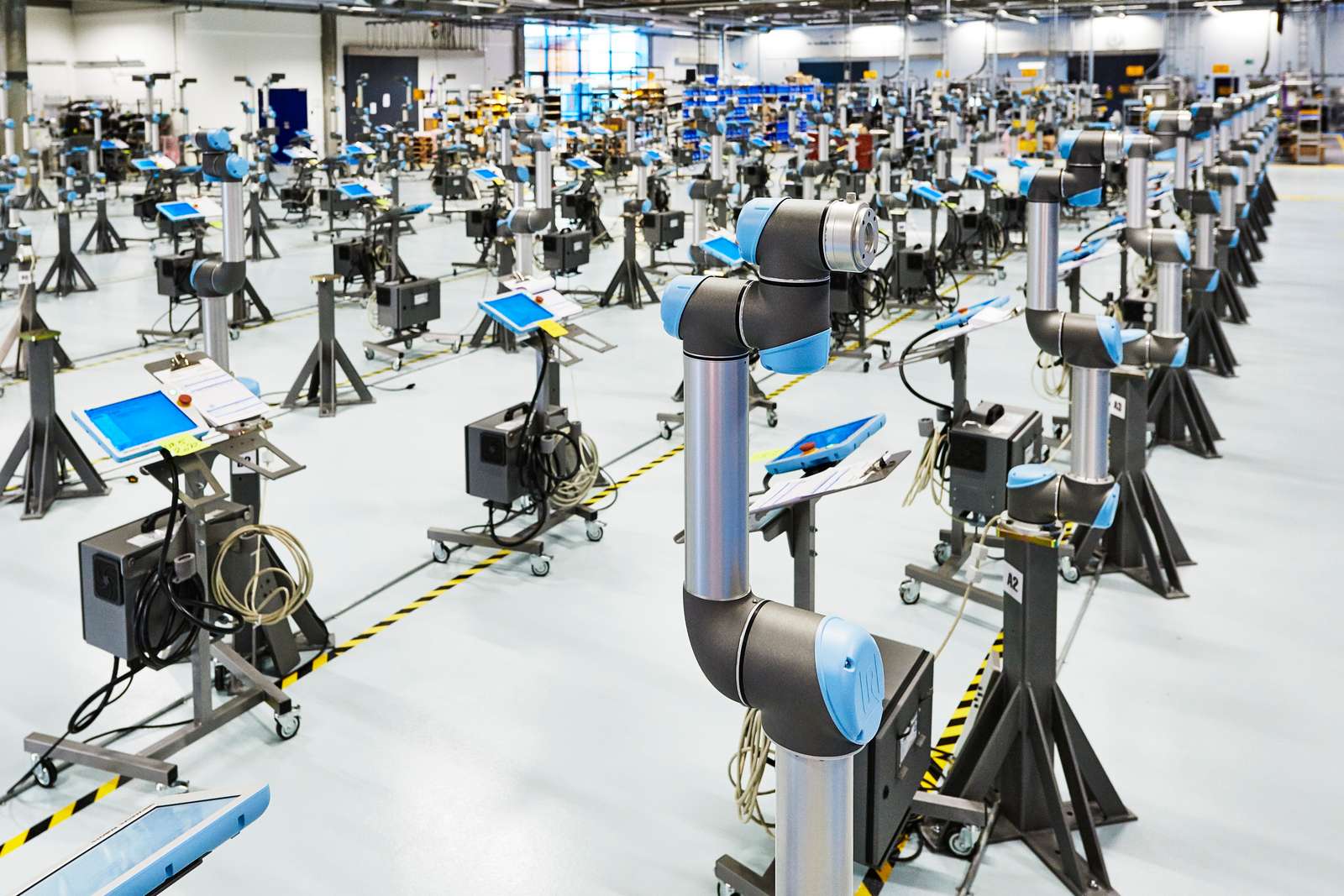
What is a collaborative robot?
You probably have a pretty good idea of what we mean by "collaborative robotics". The concept can be summed up as follows collaborative + robot = cobot.
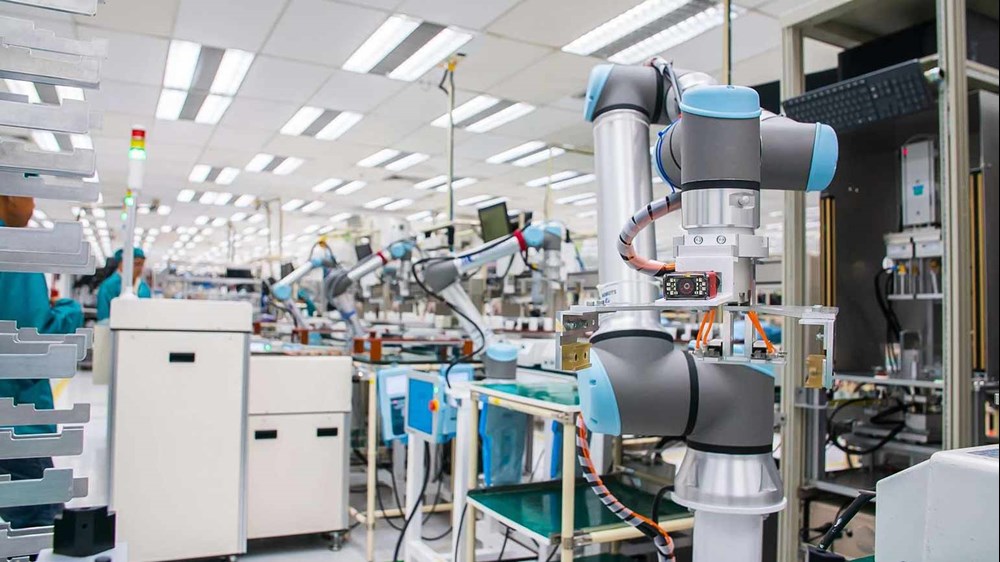
Where industrial robots excel at assembly-line work and are very fast, task-specific, rigid and often massive, cobots are relatively light, versatile, adaptive and generally smaller than their industrial counterparts. versatile, adaptive and generally smaller than its industrial counterpart..
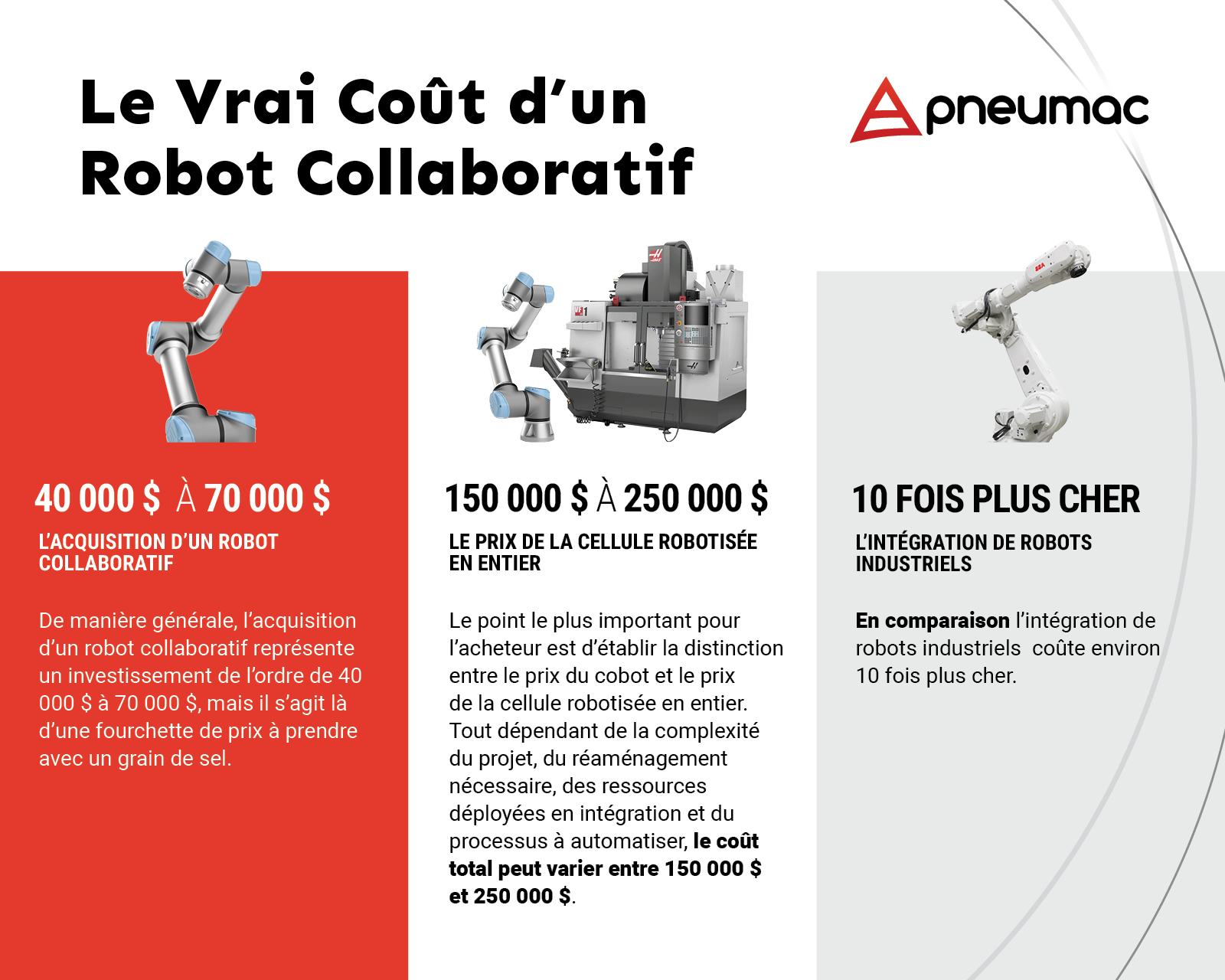
How much does a collaborative robot cost? Generally speaking, the purchase of a collaborative robot represents an investment of between $40,000 and $70,000, but this is a price range to be taken with a grain of salt. The most important point for the buyer is to establish the distinction between the price of the cobot and the price of the entire robot cell.
Depending on the complexity of the project, the redevelopment required, the integration resources deployed and the process to be automated, the total cost can vary between $150,000 and $250,000. In comparison, the integration of industrial robots costs around 10 times as much.
The cobot as an investment, not just an expense
It has to be said that simply integrating a cobot into a company's operations does not in itself create or add value. It's when it's juxtaposed and added to the components of a production cell at the beginning, middle or end of a line that the robot becomes a vector of productivity. The first thing to think about is the process to be automated. In contrast to industrial robotics solutions, cobots are versatile, modular and adaptable. In other words, you can start "small" - ensuring that the solution is robust and delivers value - before automating other segments of the production chain.
For example, buying a cobot without an integration plan in place could prove unproductive and unprofitable for a long time. Eventual integration will mean a lot of trial-and-error and wasted resources (including money).
A cobot can only be called an investment when it creates or adds value - and this can be measured in different ways:
- Reallocation of staff to value-added tasks
- Increased production capacity
- Reduced number of injuries
- Increased output quality
- Add one or more shifts
- Increased precision and repeatability
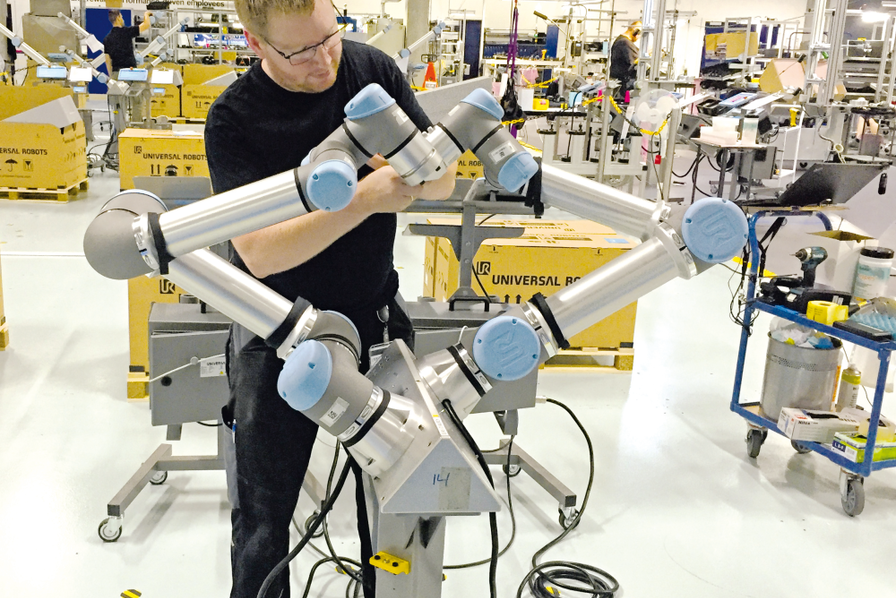
When we speak of an integration plan, we are referring above all to the hardware components, human resources and time required for initial start-up of the robotic cell. These elements form part of capital expenditure (CAPEX).
- Collaborative robot
- Robot base or stand
- End-effector tools (gripper, screwdriver, etc.)
- Parts feeder (conveyor, chute, etc.)
- Referencing device (vision system, input/output signals, etc.)
- Other hardware components (sensors, relays, compressed air supply, etc.)
- Other software components
- Safety devices
- Integration resources (internal or external)
An example of what to think about
Let's take the example of a palletizing cell. A robotrobot box sensorssensors pallet sensorssensors light curtains or surface scannersone or more grippers selected according to the load to be palletized, a compressed air supplyif required, a conveyorainterfacing systemsystem wiring and communication system interacting cell components, palletizing software palletizing softwareand much more. Added to this are integration resources.
So let's avoid any surprises: the cost of the whole cell can be two to six times more expensive than the robot itself.
You may be able to avoid the CAPEX associated with a robot by taking advantage of financing options offered by certain manufacturers. This is often a good idea for SMEs, given their limited financial resources and wildly fluctuating cash flows.
Return on investment
It has to be said that the intensive use of a cobot as part of a robotized cell must obviously enable the purchaser to "make money", i.e. to reach the break-even point - a term not to be confused with return on investment (return on investmentor ROI).

Salary savings, theaddition of a shift, the reduction in the amount of raw materials required, electricity costs, theincrease in the number of parts processed, the reduction in the number of errors and failed parts... All these aspects come into play when calculating ROI. For example, after a given period - say one year - a cobot costing $50,000 will have generated savings 20,000 (after subtracting the expenses incurred by the robot from the revenue it generates). For that year, the robot will have achieved an annual ROI of 40%.
In short, it will be enough to extend this concept to the scale of the robotic cell to get a good idea of when the break-even point will really be reached, and of the real savings generated by integrating a robot into a production line.
The importance of ease of use
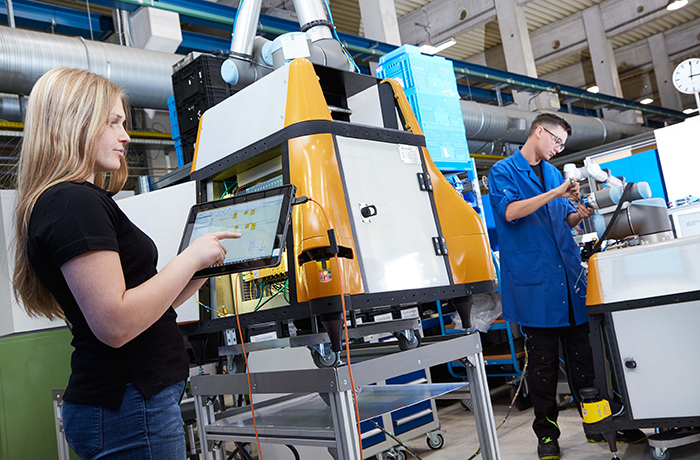
Let's not forget the imponderables: programming and reprogramming requirements. The robotic solution should be adaptive. There are a large number of events that can require programming effort - just think of product changes, tool changes, changes in material specifications, adding a step to the process, reassigning the robot to another stage of the production line and much more. That's why it's so important to have a solution that's intuitive and easy to learn, and to focus on developing robotic knowledge in-house to ease the burden of operating expenses.
Then there's the opportunity cost. This concept can be illustrated in a number of ways, but the most evocative is to imagine the consequences of a refusal to change industrial practices. By drawing two future scenarios, one with a robot and one without, we can assess how much it would cost to forego acquisition and integration. We then have to take into account the vagaries of the market, economic fluctuations and conjunctures, the labor crisis, the acceleration of technological development, the dynamism of competition, and so on. It's easy to see that simply waiting two years before embarking on an automation project can mean falling far behind in the technological race, and losing tens, if not hundreds, of thousands of dollars in potential revenues in the medium term.
Finally, how much does a collaborative robot cost, and how much could your automation project cost? Have you considered all the essential aspects? If in doubt, ask an expert from Automatisation Pneumac to do the math with you!